
Water Conductivity Range can vary from approximately 0.055 µS/cm for ideal pure water at 25°C to around 50 mS/cm for seawater. There is no single “normal” conductivity value for all water because electrical conductivity depends on the concentration and type of dissolved ions, temperature, water source, and treatment process.
Why is the Conductivity Range of Water Important?
The conductivity range of water is important for water quality management, ecological protection, industrial production and drinking water safety. Conductivity measures the concentration of dissolved ions in water and primarily reflects the level of mineral content, pollutant concentration and other dissolved substances in the water.
- Water quality assessment: Conductivity allows for the detection of pollutants and salts in water, helping to determine if the water quality is acceptable.
- Ecological protection: Different aquatic organisms have different requirements for the conductivity of water, and conductivity that is too high or too low will affect the survival of aquatic organisms.
- Drinking water safety: A high conductivity may mean that the water contains too many minerals or pollutants and is not suitable for drinking.
- Industrial production: Many industries have stringent requirements for water quality, and abnormal conductivity can affect production processes and even damage equipment.
- Water quality monitoring: Changes in conductivity can be used as an early warning to help monitor the health of a water body and whether it is eutrophic.
Typical Water Conductivity Range
The following values are practical reference ranges rather than universal regulatory limits.
| Water Type | Typical Conductivity | Engineering Interpretation |
| Ultrapure / high-purity water | ~0.055–0.1 µS/cm | Requires a low-conductivity measurement system and careful temperature control |
| Deionized water | ~0.1–10 µS/cm | Suitable for purity and ion breakthrough monitoring |
| Tap / drinking water | Tens to ~1,000 µS/cm | Strongly dependent on source water and mineral content |
| Rivers and lakes | ~50–1,500 µS/cm | Varies with geology, runoff, evaporation, and human activity |
| Wastewater | ~1–10+ mS/cm | Depends strongly on industrial inputs, salts, and treatment process |
| Seawater | ~50–55 mS/cm | High ionic concentration requires an appropriate high-range sensor |
APURE reference documentation, for example, lists approximately 0.055 µS/cm for ideal pure water, 0.1–10 µS/cm for deionized water, 1–10 mS/cm for sewage, and about 53 mS/cm for seawater.

What Does Conductivity Tell You About Water?
Electrical conductivity measures how easily water carries an electrical current.
Water containing more mobile ions generally has higher conductivity. Common conductive ions include sodium, chloride, calcium, magnesium, sulfate and other dissolved salts.
However, conductivity is not ion-specific. A conductivity meter can detect that the total ionic condition has changed, but it cannot determine which individual ion caused the change. University of Hawaii’s conductivity guidance similarly explains that conductivity responds to ions in solution rather than identifying individual dissolved species.
This distinction is important in industrial monitoring.
A sudden rise in conductivity may indicate increased salt concentration, chemical dosing, process contamination, concentrate leakage or evaporation. A sudden decrease may indicate dilution, rainwater intrusion, a change in feedwater source or loss of chemical concentration.
It should therefore be interpreted together with process conditions and, when necessary, parameters such as pH, TDS, salinity, chloride, turbidity or other application-specific measurements.
Why Does Water Conductivity Change?
Pollution of Water Bodies
- Wastewater pollution: A significant increase in the conductivity of a body of water may mean that wastewater (e.g., industrial wastewater, agricultural runoff, or municipal sewage) is discharged into the body of water, resulting in an increase in the concentration of dissolved salts, minerals, or chemical pollutants in the water.
- Organic pollution: Organic matter (e.g., food wastes or chemical wastes) may increase conductivity through inflow to the water body causing an increase in the concentration of dissolved organic matter in the water.
Abnormal Salt Concentrations
- Salt Infiltration: Excessive conductivity may indicate a high concentration of salts in the water, which may be due to excess salts from anthropogenic discharges, seawater intrusion, or agricultural irrigation.
- Mineral Concentration Abnormality: An abnormally high concentration of dissolved minerals (e.g., calcium, magnesium, sodium, etc.) in a water source can lead to an increase in conductivity, usually in hard water areas.
Water Source Variation
- Natural water source fluctuations: Conductivity changes may be due to changes in the water source, such as an increase or decrease in precipitation, resulting in changes in the concentration of dissolved substances in the water. For example, heavy rainfall may bring in large amounts of minerals and dissolved salts, resulting in increased conductivity.
- Seasonal changes: Seasonal changes may also affect the conductivity of water, e.g., during the summer months when the water is warmer, the activity of dissolved salts and minerals is enhanced, thus increasing the conductivity.
Lack of Dissolved Substances
- Low conductivity: If the conductivity of the water is abnormally low, it may mean that the water lacks sufficient dissolved substances (e.g., salts, minerals, etc.). This may be due to the fact that the water is coming from a source that has a low mineral content or that the water body is experiencing prolonged periods of evaporation, which results in a low concentration of minerals.
Unusual Water Treatment Effects
- Inadequate treatment: An inadequate water treatment process, such as incomplete removal of minerals or salts from the water, may result in an abnormally high conductivity of the water. This usually affects water quality and the health of aquatic organisms.
- Addition of chemicals: The use of excessive chemicals in water treatment (e.g. water softening salts, disinfectants, etc.) may also lead to high concentrations of dissolved substances in the water, resulting in increased conductivity.
Effects of Temperature Changes
- Temperature anomaly: When the temperature is too high, the solubility of dissolved substances in water (e.g. salt, minerals) increases, resulting in an increase in conductivity. Conversely, conductivity may decrease when the temperature is too low.
Water Conductivity Range by Industrial Application
The “correct” conductivity range is application-specific.
RO, DI and High-Purity Water
Low-conductivity applications require sensors designed to resolve very small changes in ionic contamination.
For RO permeate, deionized water and high-purity water, measurement range and cell constant are particularly important. A sensor designed primarily for high-conductivity wastewater may not provide the required resolution at very low EC levels.
Drinking and Surface Water
In drinking-water treatment, source-water monitoring and environmental applications, conductivity is commonly used as a baseline parameter.
A stable historical baseline is often more useful than comparing every measurement with a single universal value.
A significant change can prompt operators to investigate source-water changes, salt intrusion, chemical addition or other disturbances.
Wastewater
Wastewater conductivity may vary significantly because of industrial salts, cleaning chemicals, acids, alkalis, process discharges and changes in dilution.
For online wastewater monitoring, sensor range is only one consideration. Engineers should also evaluate fouling, suspended solids, chemical compatibility, installation method and cleaning requirements.
Cooling and Industrial Process Water
Conductivity can be used to follow changes in dissolved ionic concentration in recirculating systems.
In applications where evaporation concentrates dissolved salts, a rising EC trend can provide useful process information for blowdown and water-management decisions.
How do I Measure the Conductivity Range?
Measuring the conductivity range of water is primarily done through the use of a conductivity meter. A conductivity meter accurately measures the concentration of dissolved ions in the water, reflecting the water’s ability to conduct electricity, resulting in a conductivity value.
Choosing the Right Conductivity Meter
For industrial water monitoring, the right conductivity meter should be selected according to the expected conductivity range, sensor cell constant, process temperature, pressure, liquid composition, installation method, and required signal output. Matching the instrument to the actual process conditions is more reliable than selecting it only by water type.
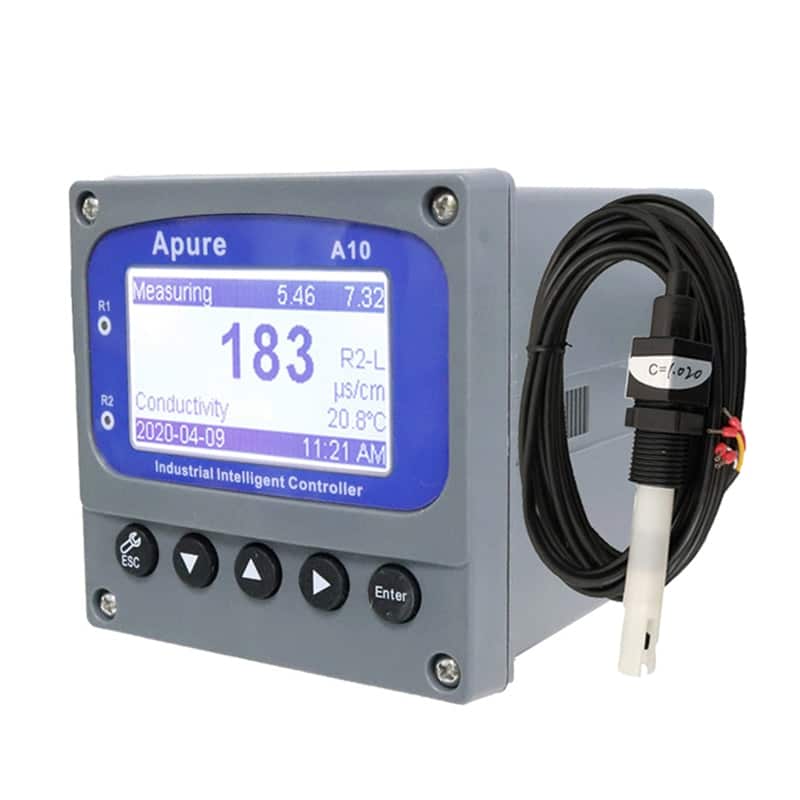
Conductivity meter/controller: An online conductivity controller displays and processes the signal from the conductivity sensor, typically in µS/cm or mS/cm. The APURE A10 EC Electrical Conductivity Meter is designed for continuous conductivity monitoring and supports temperature compensation, making it suitable for applications such as RO systems, boiler feed water, cooling water, ultrapure water, industrial processes, and water treatment.
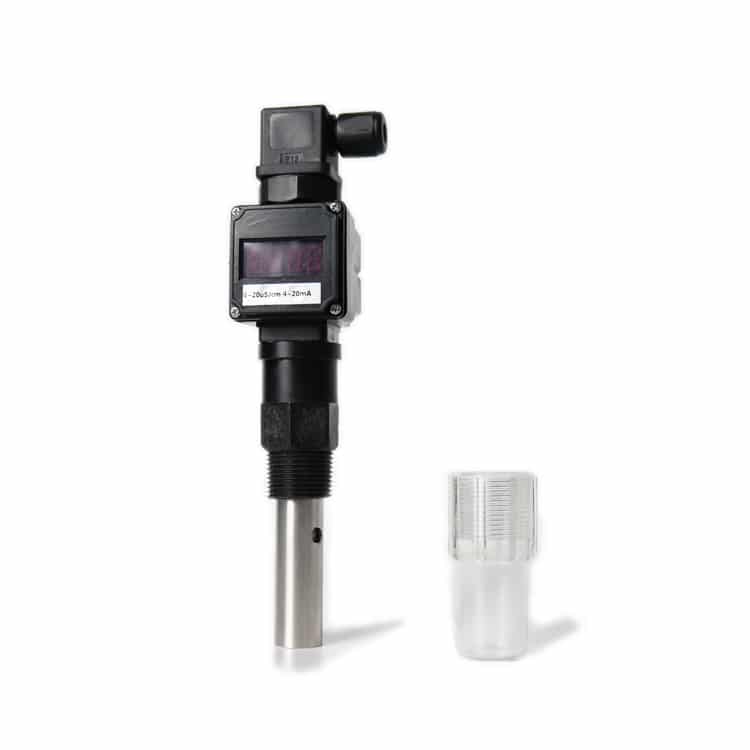
Conductivity sensor: The probe should be matched to the expected conductivity range and process conditions. The APURE KDM EC Electrical Conductivity Sensor is available in different measurement ranges for online EC/TDS monitoring. Depending on the selected model, KDM sensors support industrial communication such as RS485 Modbus RTU.
Temperature compensation: Conductivity changes with temperature, so temperature compensation is important when comparing measurements under changing process conditions. Select a meter and sensor combination with a compatible temperature sensor and compensation method.
Before selecting a conductivity measurement system, provide the minimum, normal, and maximum conductivity, together with process temperature, pressure, liquid composition, installation method, and required output signal. This helps determine the appropriate controller, sensor range, and cell constant.
Conductivity vs. TDS and Salinity
Conductivity, TDS and salinity are related but are not identical measurements.
Conductivity measures electrical conduction caused by ions in the solution.
TDS is an estimate or measurement of dissolved solids, while salinity describes the concentration of dissolved salts. Instruments may estimate TDS or salinity from conductivity, but the conversion depends on solution composition, temperature and the conversion model used.
Therefore, a fixed conductivity-to-TDS or conductivity-to-salinity factor should not automatically be assumed for every industrial water stream.
Summary
Conductivity range of water By monitoring conductivity, the concentration of dissolved substances in water can be known in real time, which in turn helps to determine the level of contamination of the water body, its ecological health and whether it meets the standards for drinking water or industrial use.
Apure Manufacturers specialise in the development and research of water quality testing instruments that provide a strong support for safeguarding water quality. We manufacture a range of water quality monitoring instruments including flow meters, level measurement, pressure measurement and ozone generators.
Need Help Selecting a Conductivity Sensor?
For industrial water, wastewater, RO, cooling-water or process-water monitoring, provide your actual operating conditions rather than only the water type.
Request a quotation: Send the expected conductivity range, operating temperature, pressure, installation method and required signal output.
Send wastewater data for design: Include typical/minimum/maximum conductivity, temperature, pH, TDS or salinity if available, solids/fouling conditions and process information.
Contact for engineering solution: APURE can review the application conditions and help identify a suitable conductivity measurement configuration.