
See how aquaculture water quality monitoring connects DO, pH and nutrient sensors with real-time alarms, aeration and water-exchange control.
Aquaculture Water Quality Monitoring Case Studies
In intensive aquaculture, water quality can change much faster than periodic manual testing can capture. Dissolved oxygen, pH, ammonia-related parameters and other indicators directly affect the environment in which fish or shrimp live.
Across aquaculture projects in Hainan, Xinjiang and Kunming, APURE monitoring systems were applied around one practical control loop:
Pond / Tank → Water Quality Sensors → Real-Time Data → Alarm → Aeration / Water Exchange → Stable Aquaculture
The three projects cover different species and operating conditions, but the objective is the same: detect water-quality changes early enough for farm operators to respond before they affect production.
Three Farms, Three Water Quality Risks
The monitoring configuration changes according to the cultured species and operating environment.
Hainan shrimp farm: A large intensive shrimp facility with more than 500 m³ of culture water and annual production above 2 million shrimp. The main challenge was detecting rapid changes such as dissolved oxygen depletion and ammonia-related increases.
Xinjiang salmon farm: A high-value cold-water aquaculture site producing approximately 3,000 metric tons annually. Large day-night temperature and pressure variations made dissolved oxygen stability a major operational concern.
Kunming ornamental fish farm: Multiple tanks for high-value ornamental fish required stable water conditions and centralized monitoring across the facility.
This is why aquaculture monitoring should be configured around the actual culture risk rather than using the same sensor package for every farm.
1. Pond / Tank: Monitor the Water Where the Stock Lives
The Hainan project used multiparameter monitoring at individual culture ponds, covering indicators such as:
- Dissolved oxygen
- pH
- Ammonia-related parameters
- Nitrite
- Total phosphorus / total nitrogen
Sensors were designed for long-term operation in aquaculture water, with anti-fouling and corrosion-resistant protection to reduce maintenance requirements.
The Xinjiang project placed particular emphasis on fluorescence-based dissolved oxygen monitoring, while the Kunming facility combined several parameters across multiple tanks for centralized water-quality management.
FAO guidance also identifies dissolved oxygen as one of the most important pond-water parameters and notes that intensive aquaculture commonly requires aeration to avoid oxygen depletion.

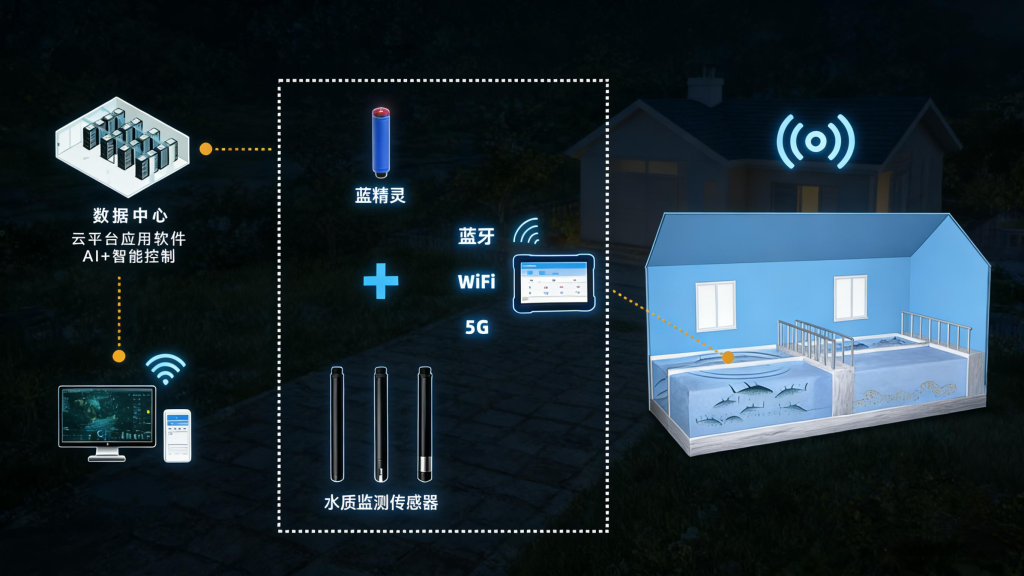
2. Real-Time Data: Replace Sampling Gaps With Continuous Visibility
The main difference from periodic testing is not simply more data. It is knowing when water quality begins to change.
Sensor readings from the ponds or tanks were transmitted to centralized monitoring platforms, allowing operators to review conditions remotely instead of checking each location manually.
The operational chain becomes:
Sensor Measurement → Real-Time Data → Trend Review → Abnormal Condition
In the Hainan project, farm operators could view individual pond data through a management platform and mobile interface. The Kunming facility used centralized displays to compare multiple tanks, while the Xinjiang project transmitted dissolved oxygen data to a cloud platform for continuous monitoring.
APURE’s IoT architecture supports remote collection of water-quality instrument data and centralized monitoring through wireless communication.
3. Alarm to Action: Connect Water Quality With Farm Operation
For aquaculture, an alarm only has value if it leads to an operational response.
In the Hainan project, project-specific thresholds were configured for parameters including dissolved oxygen and ammonia nitrogen. When abnormal conditions were detected, the system could trigger alarms and support linkage with aerators and water-exchange valves.
The Xinjiang salmon project used the same principle with dissolved oxygen:
DO Change → Alarm → Aerator Control
For the Kunming ornamental fish facility, real-time data supported control of equipment such as aeration, water circulation and protein separation systems.
This creates a closed-loop operating model:
Measure → Detect → Alarm → Adjust → Stabilize
That is the main difference between a standalone aquaculture sensor and an integrated aquaculture water quality monitoring system.
What Changed After Continuous Monitoring?
The three projects produced different operational benefits.
| Project | Reported Result |
| Hainan Shrimp Farm | Survival rate increased from 82% to 95% |
| Manual labor cost reduced by 40% | |
| Feed waste reduced by 15% | |
| Water consumption reduced by 20% | |
| Culture cycle shortened by 8 days | |
| Total production increased by 25% | |
| Xinjiang Salmon Farm | 24/7 dissolved oxygen monitoring |
| Manual testing cost reduced by about 90% | |
| Precision aeration reduced electricity use by about 20% | |
| Kunming Ornamental Fish Farm | Water-quality abnormalities detected earlier across multiple tanks |
| More than 90% of routine testing time was saved | |
| Fish survival and quality were reported to improve |
The value of continuous monitoring is therefore not limited to laboratory-style measurement. It helps farm operators use water-quality data to make faster aeration, circulation and water-exchange decisions.
One Aquaculture Monitoring Loop
The three projects can be summarized in one operating chain:
Pond / Tank
↓
DO + pH + Ammonia / Nitrite + Multiparameter Sensors
↓
Real-Time Data
↓
Automatic Alarm
↓
Aeration / Water Exchange / Circulation
↓
Stable Aquaculture Environment
For shrimp farms, fish farms and high-value aquaculture facilities, the objective is not to monitor every possible parameter. It is to identify the parameters that influence production, detect changes continuously and connect those measurements with practical farm actions.

Planning an Aquaculture Water Quality Monitoring Project?
APURE can help configure sensors, monitoring points, alarms and equipment linkage for fish farms, shrimp farms and other aquaculture systems.
Request a Quotation
Send the cultured species, number and size of ponds or tanks, required parameters, project location and communication requirements.
Request a QuotationSend Aquaculture Water Data for Design
Provide available DO, pH, ammonia, nitrite and temperature ranges together with aeration and water-exchange conditions. For wastewater projects, send wastewater data for design.
View Multiparameter Monitoring →Contact for Engineering Solution
Discuss sensor selection, pond layout, alarm thresholds, wireless monitoring and linkage with aerators, pumps or circulation equipment.
View Water Quality Solutions →