
Industrial wastewater monitoring system at a Beijing WWTP used influent and effluent monitoring to improve process control and reduce chemical dosing by about 15%.
Project Background
A centralized wastewater treatment plant in a large industrial park in Beijing receives combined wastewater from dozens of different factories.
Because the wastewater composition and concentration can change significantly, the plant faced three connected problems: unpredictable influent quality, delayed process adjustment and pressure to maintain stable effluent quality.
Traditional single-parameter monitoring could not provide enough information to respond quickly to changing industrial wastewater loads. The plant therefore required an industrial wastewater monitoring system capable of detecting influent changes early and continuously checking treatment performance at the outlet.

Dual Influent and Effluent Monitoring
Full-spectrum multiparameter water quality sensors were installed at both the influent and effluent monitoring points.
Using UV-Vis full-spectrum analysis, the system monitored multiple indicators including:
The two monitoring locations served different purposes.
Influent monitoring acted as an early-warning point. When incoming wastewater quality changed or a shock load appeared, operators could identify the change earlier and prepare process adjustments.
Effluent monitoring acted as the final control point. It continuously tracked treated water quality and provided additional information on whether the treatment process remained stable.
For similar applications, see APURE’s Multiparameter Water Quality Monitoring and online COD sensor solutions.
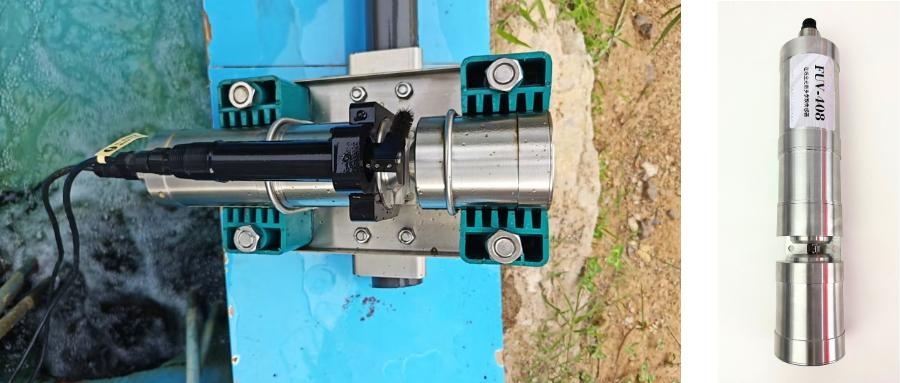
From Water Quality Data to Process Control
The monitoring data were transmitted in real time to the plant’s central control platform.
Instead of relying mainly on operator experience after water quality had already changed, the plant could use monitoring data to support adjustments to:
chemical dosing + aeration
The operating logic became:
Influent monitoring → detect load change → adjust treatment process → effluent monitoring → verify treatment result
This is particularly important for industrial wastewater plants because monitoring has greater commercial value when the data are connected to actual process decisions rather than used only for recording.
EPA technical material similarly notes that online process monitoring can help wastewater plants identify treatment upsets and improve the use of energy and chemicals.
Project Results
| Indicator | Project Result |
| Effluent control | 100% compliance with the applicable Beijing local discharge standard during the reported period |
| Chemical dosing | Reduced by approximately 15% |
| Process control | Influent data used to support earlier dosing and aeration adjustment |
| Instrument maintenance | Reagent-free, low-maintenance monitoring reduced routine workload |
The most commercially significant result was the approximately 15% reduction in flocculant and related chemical dosing, achieved through more precise monitoring and process adjustment.
The project record also reports stable effluent performance, with 100% compliance with the applicable Beijing local discharge standard during the reported period. This is a project-specific result and should not be interpreted as a universal performance guarantee.
What to Specify for a Similar Industrial Wastewater Project
For EPC companies, industrial parks and wastewater plant operators, instrument selection should start with the actual process requirements:
- Wastewater characteristics: expected COD, TOC, ammonia nitrogen, turbidity and concentration variation
- Monitoring locations: influent only, effluent only, or dual-point monitoring
- Process objective: shock-load warning, dosing optimization, aeration control or effluent verification
- System integration: data transmission to PLC, SCADA or a central monitoring platform
The Beijing case shows that a properly configured industrial wastewater monitoring system can function as both an early-warning tool and a process-control data source.
Need an Industrial Wastewater Monitoring Solution?
APURE provides monitoring solutions for industrial wastewater influent, effluent and process-control applications.
Request a Quotation
Send your required parameters, monitoring points, wastewater characteristics and project location.
Request a QuotationSend Wastewater Data for Design
Provide COD, TOC, ammonia nitrogen, turbidity ranges, influent fluctuations and required communication interfaces.
View Multiparameter Monitoring →Contact for Engineering Solution
Discuss influent and effluent monitoring, shock-load detection, dosing optimization and wastewater process control.
View Online COD Sensors →