
Electrical conductivity (EC) and total dissolved solids (TDS) are different measurements. EC describes a solution’s ability to carry electrical current. TDS describes dissolved residue under a specified determination method. A conductivity-based TDS meter estimates TDS using a configured relationship; it does not directly identify and weigh every dissolved substance.
What electrical conductivity measures
In water, mobile ions carry current. Conductivity therefore depends on ionic composition, concentration and temperature. Pure water has very low but nonzero conductivity because water itself dissociates slightly into ions; a commonly cited value is about 0.055 µS/cm at 25°C. Exposure to air or contamination can change a high-purity-water sample, so its measurement needs appropriate handling.
Report the complete unit: typically µS/cm or mS/cm, rather than siemens alone. 1 mS/cm = 1,000 µS/cm. A unit conversion does not compensate for temperature. Use the conductivity unit converter for the arithmetic and compare the same temperature basis.
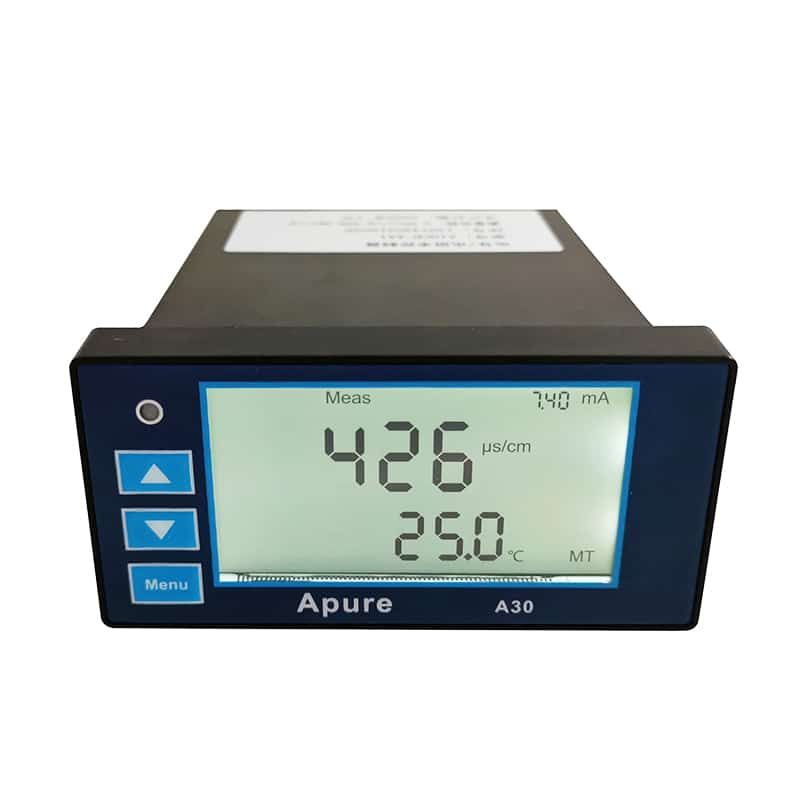
What TDS means
A reference TDS determination uses a specified procedure for separating suspended material, drying the dissolved residue and weighing it. Its preparation and drying conditions define the reported result. A handheld meter usually derives an estimate from conductivity instead. Nonionic dissolved material and changes in ionic composition can make that estimate disagree with a reference result.
On a phone, swipe comparison tables sideways to see every column.
| Item | EC result | Conductivity-derived TDS estimate |
|---|---|---|
| Reported quantity | Electrical conductivity, such as µS/cm. | Estimated concentration, commonly mg/L or a meter’s ppm scale. |
| Main dependencies | Ionic composition, concentration, temperature and measuring cell. | The EC measurement plus the selected conversion relationship and assumptions. |
| Comparison requirement | Same full unit and temperature-compensation basis. | Same EC basis, factor/scale and sample composition; confirm the reference method when accuracy matters. |
| Cannot establish alone | The concentration of each contaminant or drinking-water safety. | A full contaminant analysis, microbiological safety or universal process suitability. |
An illustrative EC-to-TDS calculation
If an instrument is explicitly configured to estimate TDS as EC in µS/cm multiplied by 0.50, a reading of 500 µS/cm gives an estimated 250 mg/L. With a factor of 0.70, the same EC gives 350 mg/L. These assumed factors illustrate why two meters can disagree; neither factor is a universal water-quality conversion or an actual Apure test result.
Record the meter’s factor or scale and follow its unit convention. Do not compare a value based on EC normalized to 25°C with an uncompensated reading at another temperature as though they were equivalent. Use a verified relationship to the relevant reference method where the decision requires it.
Does low TDS mean good or safe water?
No single EC or TDS interval proves water is suitable for every use. Drinking water, semiconductor rinsing, boilers and aquaculture have different requirements. Even a low reading can coexist with contaminants that the instrument does not measure. State the region, intended use, analyte and method when citing a requirement; do not turn an aesthetic TDS guideline into a complete drinking-water safety test.
Choose and compare meters
- Define the actual measurement and operating interval, then select a compatible sensor and cell constant. A wider advertised range does not by itself prove better or worse accuracy.
- Check the accuracy specification at the operating point, temperature measurement, compensation model and reference temperature.
- Calibrate and independently verify with suitable standards. Record the standard certificate, sensor, settings and sample conditions.
- For TDS, document the conversion scale and justify its use for that sample. Confirm unexpected or decision-critical results with the required reference method.
See conductivity standards and calibration and the Apure EC/TDS instrument range. Confirm each supplied model’s actual EC range and units instead of using another instrument’s pH specifications.